
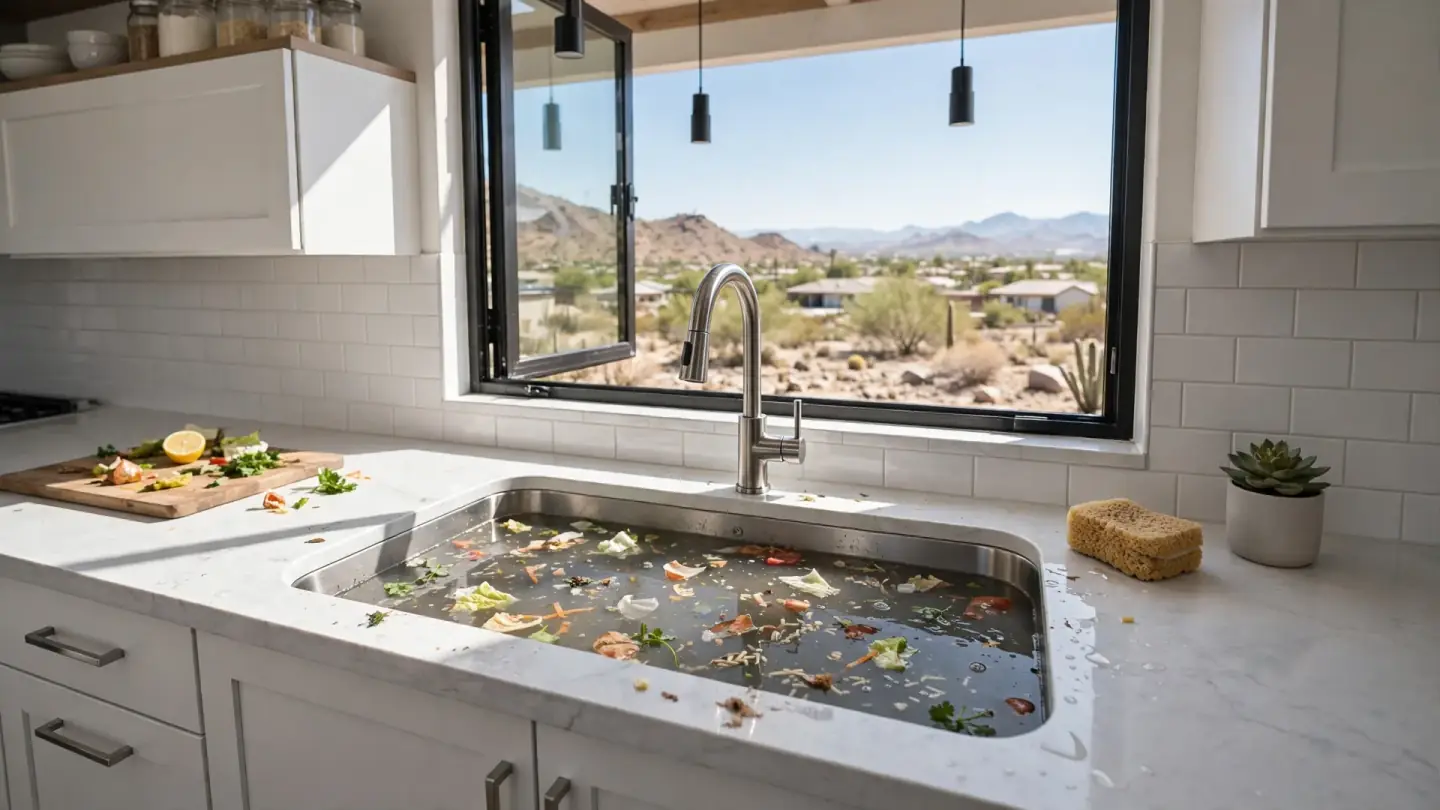
Key facts: Water softeners and drain scale
- Ion-exchange softeners swap calcium and magnesium ions for sodium or potassium ions using resin beads [1].
- The resin is regenerated with a salt brine, and that waste water is typically sent to the sewer [1].
- Softened water is poorly suited to irrigation because sodium can lead to alkali soils [1].
- Henderson's tap water comes from Lake Mead and falls in the very hard range [2][3].
Short answer
What does a softener actually change for drains?
A conventional softener passes your water through resin beads that hold on to calcium and magnesium and release sodium or potassium in their place [1]. With fewer hardness minerals in the water, less scale forms on fixtures and pipe walls from that point on.
What it doesn't do is reach back in time. Crust that built up over years in a trap, a tub drain or a laundry line stays there. Softened water may slowly loosen some soft deposits, but nobody should count on it to reopen a narrowed pipe.
Henderson's water comes from Lake Mead and is very hard by USGS standards [2][3], so softeners are common here. This guide looks at them only from the drain side. For the wider picture of crust inside pipes, read the hard water scale guide.
Symptom check
Drain symptoms in a home with a softener
| What you see | Likely cause | What to do |
|---|---|---|
| Drains slow even though the softener works | Old scale or hair and grease already in the pipes | Have the line cleared; softening won't remove it |
| Puddle by the softener after regeneration | Discharge line kinked, blocked or jammed into a clogged standpipe | Put softener on bypass and check the drain |
| White crust returns quickly on fixtures | Softener out of salt, set wrong or bypassed | Check salt and settings with the installer |
| Gurgling at the laundry when the softener runs | Shared drain restricted downstream | Call to have the branch cleared |
| Salty crust at the drain point | Brine drying where discharge splashes | Clean and confirm the air gap is correct |
Softener operation summarized from the water softening reference [1].
Safe checks
Checking the softener's own drain line
The softener needs a working drain as much as any sink. These checks are safe for most owners.
- 1
Trace the discharge tube
Follow the small hose from the control head to where it empties. It usually ends at a laundry standpipe, a floor drain or a dedicated drain fitting.
- 2
Look for the air gap
The tube should end above the drain opening, not pushed inside it. That gap keeps drain water from being drawn back toward the softener.
- 3
Check for kinks and crust
Straighten any bends and look for salt crust at the outlet that could narrow it.
- 4
Watch one regeneration
Many units let you start a manual cycle. Watch the drain point and confirm it takes the flow without backing up.
- 5
Keep the brine away from plants
Don't redirect the discharge to the yard; sodium-rich water harms soil [1].
Cause in depth
Why existing crust doesn't simply wash away
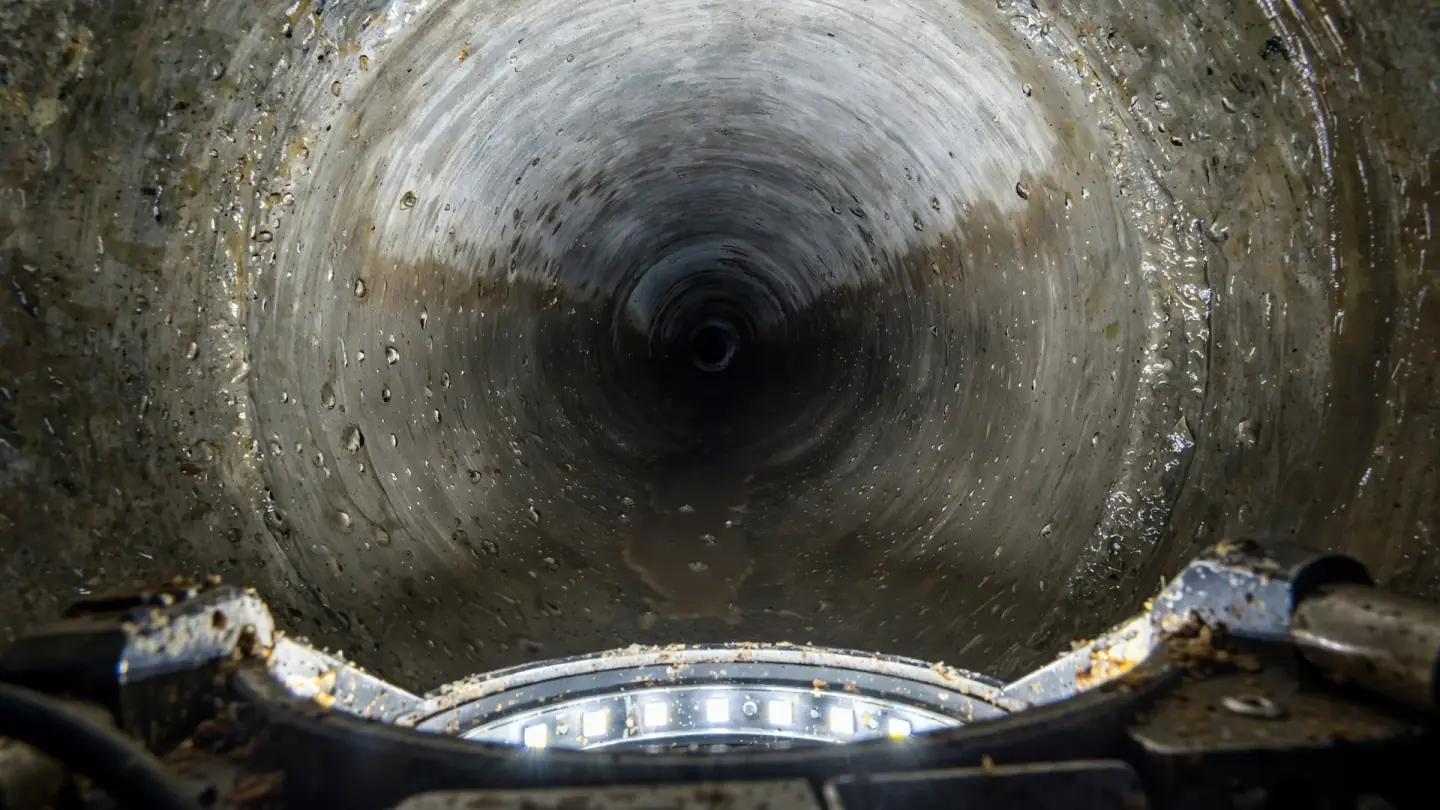
Scale builds in thin layers of calcium and magnesium carbonate, and heat speeds it up [4]. Once those layers bond to a pipe wall, they're hard and mostly insoluble in plain water. Soft water reduces new deposits but doesn't dissolve old ones to any useful degree.
That's why a house can get a brand-new softener and still have a slow tub or laundry line the following week. The drain was narrowed before the softener arrived. Clearing it, then softening, gives you the full benefit. The hydro jetting page explains how built-up crust is scoured off pipe walls.
Cause in depth
Brine discharge and the drain it lands in
During regeneration, a softener sends a mix of brine and the minerals it removed to the drain [1]. On industrial scale, that discharge has been noted to drop scale of its own into sewer systems [1]. In a home, the bigger issue is simpler: the softener often drains into the same standpipe as the washer, and if that pipe is half full of lint, the extra water spills.
If your laundry floor has ever been wet in the morning with no laundry running, the softener's overnight cycle is the likely source. That situation is covered on the laundry and softener overflow page.
Salt-free options
Are salt-free conditioners different for drains?
Some products called conditioners don't remove hardness at all. Methods such as template-assisted crystallization change how minerals behave so they're less likely to form scale on surfaces [1]. They also don't need a brine discharge line. Magnetic devices are a different story; the reference literature doesn't support their scale-reduction claims [1].
From a drain point of view, the key differences are the discharge line and whether the product is proven. Ask any installer how their system handles Henderson's very hard water and what it does with existing scale.
How a pro diagnoses it
What a drain contractor checks in a softened home
The independent contractor will usually ask whether the softener is working and how long it has been in place. If slow drains predate it, they'll treat the lines as scaled and clear them with a cable or jetter, often checking with a camera. They'll also look at where the softener discharges and whether the air gap is right.
A softener installer handles the unit itself: salt, settings and resin. A drain contractor handles the pipes. If you're not sure which you need, describe both symptoms when you call. The preventative drain maintenance page covers scheduled cleaning in hard-water homes.
Prevention
Getting the most from a softener for your drains
- Clear any slow lines before or soon after installing a softener.
- Keep the salt topped up so the unit doesn't quietly stop softening.
- Make sure the discharge has an air gap and its own clear path.
- Keep up lint traps and hair catchers; soft water won't stop those clogs.
- Look at the grate routine in the shower drain scale guide for fixtures that still crust.
FAQ
Softener and drain questions Henderson households ask
Answers on softeners from the drain side; more on the [questions hub](/faq/). Back to [all guides](/guides/).
Will installing a water softener clear my already slow drains?
A water softener won't clear drains that are already slow, because it only reduces new scale. Crust already bonded inside a pipe stays in place, and hair or grease clogs are unaffected. Have the slow lines cleared first, then let the softener help keep them from narrowing again.
Where is a water softener supposed to drain in a Henderson house?
A softener usually drains to a laundry standpipe, a floor drain or a dedicated drain fitting, with the tube ending above the opening to leave an air gap. Its brine waste is normally sent to the sewer [1]. Don't route it into landscaping, since sodium-rich water harms soil.
Can the brine from a softener damage drain pipes?
Household softener brine is normally sent to the drain without harming typical residential pipes [1]. The more common problem is volume: a regeneration cycle into an already clogged standpipe can overflow. Keep the discharge path clear and check it if the laundry floor is ever wet in the morning.
Do salt-free water conditioners help prevent drain scale?
Some salt-free conditioners, such as template-assisted crystallization systems, aim to reduce scale formation without removing minerals [1]. Magnetic devices aren't supported by the evidence. Ask any installer what results they can show in very hard water like Henderson's, and remember no conditioner removes existing crust.
Why do I still see white crust on fixtures after getting a softener?
White crust after installing a softener usually means it's out of salt, set for the wrong hardness, or bypassed. Old deposits also don't vanish on their own. Check the salt and settings with your installer, then clean the fixtures once so you can see whether new crust forms.
Should a drain contractor or a softener company look at my problem?
A drain contractor handles clogged or scaled pipes, while a softener company handles the unit's salt, settings and resin. If drains are slow or overflowing, start with a drain contractor. If fixtures crust quickly despite a softener, start with the installer.