
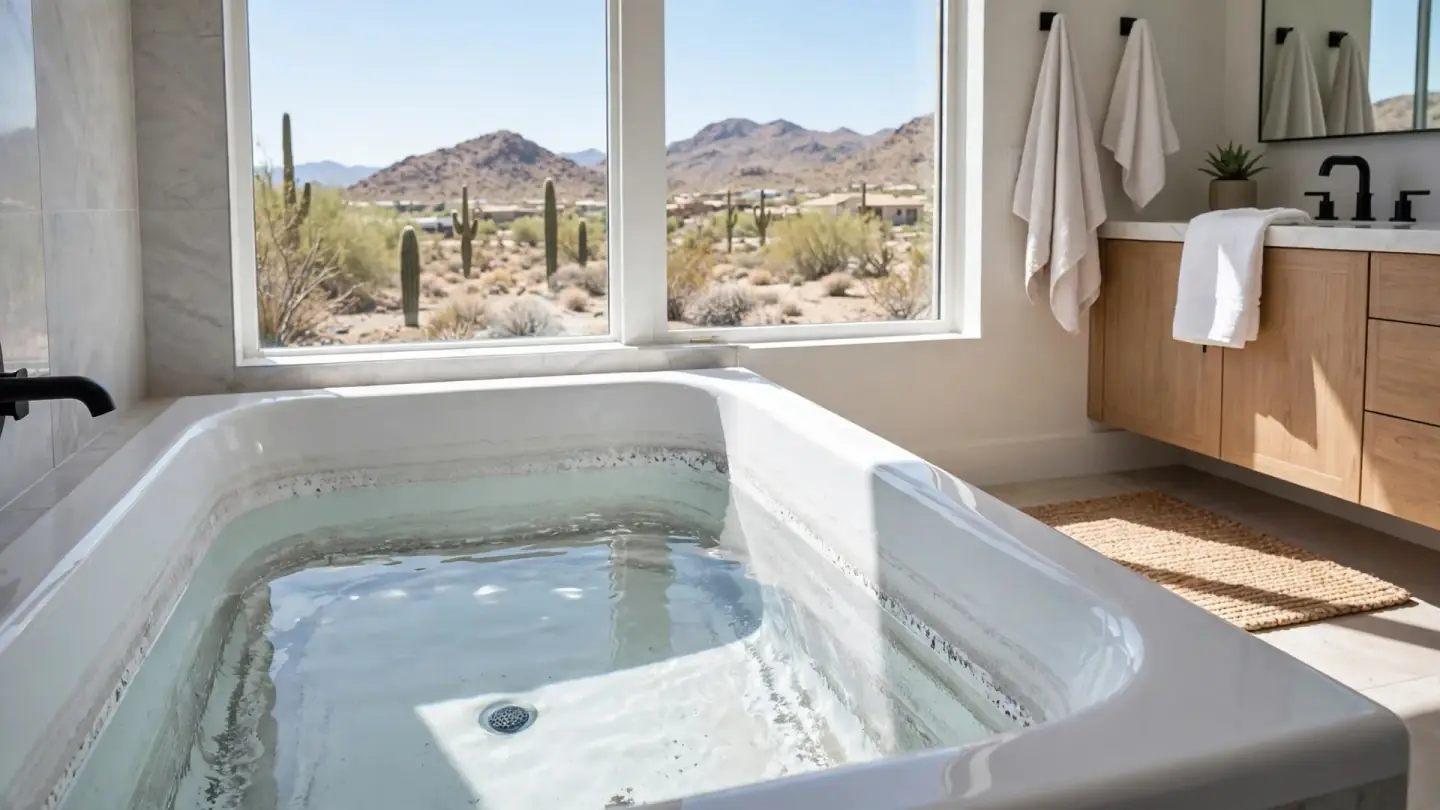
Key facts: Hard water scale buildup in drains
- All of Henderson's water is Colorado River water taken from Lake Mead, picking up calcium and magnesium along the way [1].
- City material puts local hardness at roughly 16 grains per gallon, well above the 180 mg/L line the USGS uses for very hard water [1][2].
- Hard water leaves calcium and magnesium carbonate scale on surfaces, and heating the water makes more of it form [3].
- The minerals pose no health risk; the problem is the gradual crust they leave inside fixtures and drain lines [1].
Short answer
Does hard water really clog drains?
Not on its own, and not overnight. Minerals rarely seal a pipe shut by themselves. What they do is build a thin, rough lining that shrinks the opening and gives everything else something to grab.
In Henderson that lining forms faster than in many cities. The city's water report says every drop is drawn from Lake Mead, which the Colorado River feeds, and it arrives carrying calcium and magnesium [1]. City material puts hardness at around 16 grains of hardness per gallon, which lands firmly in the USGS "very hard" range of more than 180 mg/L [1][2].
So the honest answer is that hard water scale buildup in drains is the slow background cause, while hair, soap film and kitchen grease are what finally stop the water. Fixing the clog without dealing with the crust usually means you will see it again.
Restaurants and other businesses deal with scale plus grease; the commercial drain cleaning page explains how that combination is handled.
Know your number
How Henderson water compares on the hardness scale
The USGS sorts water into four bands by dissolved minerals, measured as calcium carbonate [2].
| Category | Range (mg/L as CaCO3) | What it means for drains |
|---|---|---|
| Soft | 0 to 60 | Little or no visible scale |
| Moderately hard | 61 to 120 | Light film on fixtures over time |
| Hard | 121 to 180 | Noticeable crust on aerators and shower heads |
| Very hard | Above 180 | Steady scale inside traps, tub drains and hot-water lines |
| Henderson tap water | Roughly 270 to 300 (about 16 gpg) | Very hard: expect buildup to be part of normal upkeep |
Henderson figures are from the city's water quality material [1]; bands are from the USGS [2].
Clues around the house
Signs scale is building inside your pipes
You cannot see inside a drain, but the visible fixtures give strong hints about what is happening further down.
White or tan rings at the drain
Chalky deposits around a sink or tub opening usually continue into the tailpiece and trap below.
Crusty stoppers and strainers
Pop-up stoppers that stick or feel gritty are often coated on the parts you cannot see.
Slow drains that never fully recover
A plunger helps for a week, then the sink is sluggish again because the narrowed pipe keeps catching debris.
Gritty flakes after cleaning
Small hard chips that come up with a drain stick or hook are mineral scale breaking loose.
Worse in hot-water fixtures
Showers, tubs and dishwasher lines tend to scale first, since heated water drops minerals more readily [3].
The mechanics
Why do heat and desert living speed up scale?
Scale forms when dissolved minerals come out of the water and stick to a surface. Warming water encourages that, which is why the inside of a kettle crusts over [3]. Your shower drain, tub drain and laundry standpipe handle warm water every day, so they collect the most.
Evaporation helps too. When a basin dries out between uses, the minerals left behind stay put. Henderson summers are long and hot, with average July highs near 101°F [4], so wet surfaces dry quickly and leave a fresh layer each time.
Over months the layers stack up, and that is how hard water scale buildup in drains quietly develops. A drain that started at full size slowly narrows, and its rough walls become a net for hair and soap. That is the moment most people notice a problem, even though the groundwork was laid years earlier.
DIY-safe routine
A gentle monthly routine for scale-prone drains
These steps are low risk for most fixtures. Skip anything that involves strong chemicals; mixing drain products can be dangerous [5].
- 1
Pull and soak the stopper
Remove the sink pop-up or tub strainer and soak it in white vinegar for an hour. Scrub off the softened crust with an old toothbrush.
- 2
Clear the visible hair
Use a plastic drain stick to lift out hair before it bonds to the rough lining just below the opening.
- 3
Flush with hot tap water
Run hot water for a minute or two after the cleanup to carry loose flakes away rather than letting them settle in the trap.
- 4
Wipe fixtures dry
A quick wipe of the basin and drain ring after use leaves fewer minerals to harden there.
- 5
Note what keeps coming back
If one drain slows again within weeks, write that down. Repeat clogs in the same spot point to a narrowed pipe, not just debris.
When to call
When a scaled drain needs a professional
Call when the same drain clogs again and again, when several fixtures slow at once, or when a monthly routine no longer makes a difference. Those patterns suggest the narrowing is deeper than a stopper can reach.
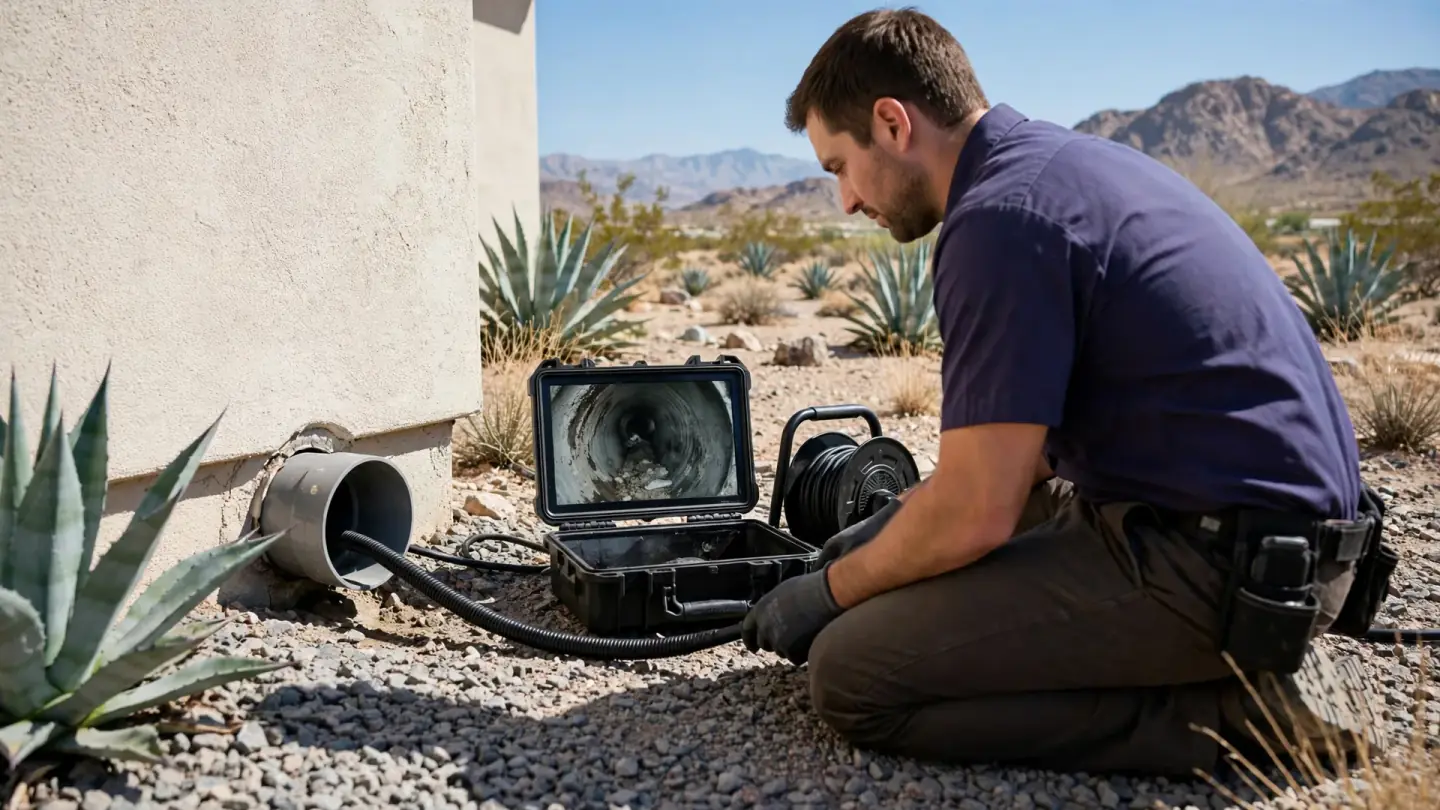
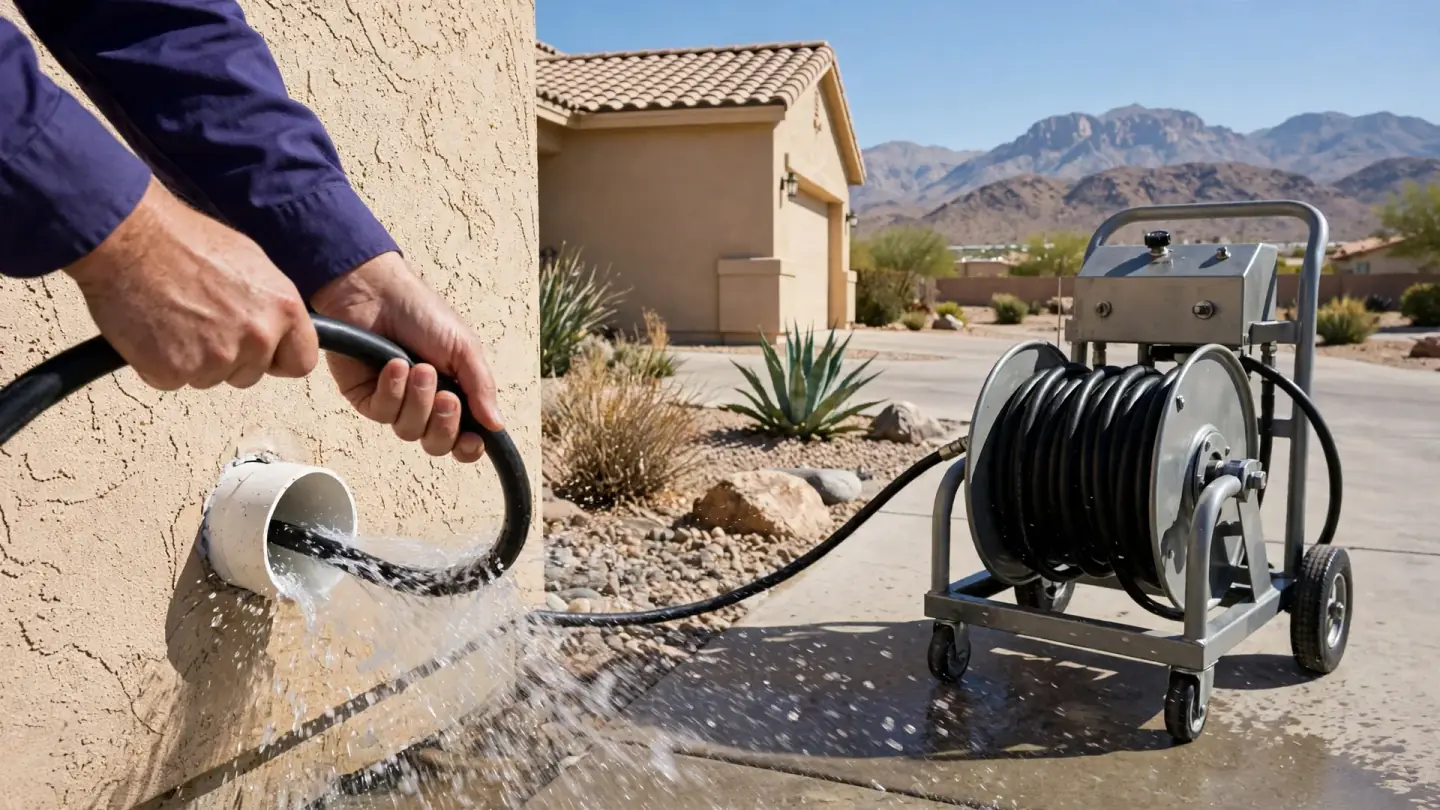
The contractor you are connected with may run a cable through the line or recommend hydro-jetting, which scours the pipe wall instead of just punching a hole through the clog. A drain camera inspection can show how much of the pipe is coated before anyone decides on a method.
For a single slow basin, start with bathroom drain cleaning. If water is backing up and you cannot use a fixture, check emergency clogged drain service availability.
- Same drain clogs every few weeks
- Two or more fixtures slow together
- Hard chips or flakes keep coming up
- Standing water you cannot clear safely
Long term
Habits that slow scale down
- Use strainers in every tub and shower so hair never meets the rough pipe lining.
- Keep grease out of the kitchen sink; it bonds to scale and hardens fast. Our guide on what not to pour down drains covers the worst offenders.
- Talk to a plumber about whether water treatment suits your home; softened or conditioned water leaves less behind.
- Ask about scheduled preventative drain maintenance if your home is older or has had repeat clogs.
- Watch tub and shower drains most closely, since they handle the most warm water.
FAQ
Scale and hard water drain questions for Henderson
Answers here focus on hard water scale buildup in drains; see the [full FAQ](/faq/) for more. Back to [the guide library](/guides/).
How hard is Henderson's tap water compared with other cities?
Henderson's tap water measures approximately 16 grains per gallon, which the city reports as very hard [1]. The USGS classes anything above 180 mg/L as very hard, and Henderson sits well past that line [2]. The minerals come from the Colorado River as it flows into Lake Mead, so nearly every home in the city deals with the same scale-forming water.
Why does scale build up faster in drains that carry hot water?
Hot water drains build scale faster because heating water causes more calcium and magnesium carbonate to come out of solution and settle on surfaces [3]. Showers, dishwasher outlets and laundry lines carry warm water most often. That is why those drains in Henderson homes tend to crust over sooner than a cold-water utility sink, even when they carry similar amounts of debris.
Can mineral scale cause a drain to clog even without much hair or grease?
Mineral scale alone rarely seals a drain shut, but it narrows the pipe and leaves a rough surface that catches whatever passes. Small amounts of hair, soap and food then snag and stack up much faster than in a smooth pipe. In Henderson's very hard water [1], a modest amount of debris on top of years of scale is a common recipe for a stubborn clog.
Should I use acid drain cleaner to dissolve scale in my pipes?
Acid drain cleaners are strongly corrosive and can harm skin, fixtures and some pipe materials, and mixing them with other products can be dangerous [5]. For scale inside drain lines, mechanical cleaning is usually the safer route. A local drain company can use a cable or water jetting to scour the pipe wall instead of relying on harsh chemicals sitting in the line.
Does hard water scale affect drain pipes in older Green Valley homes more?
Older Henderson neighbourhoods such as Green Valley, which began developing in the late 1970s [7], have simply had more years of very hard water flowing through their drains. Scale builds slowly, so a house that has been in service for decades usually carries more of it than a new build. Age alone doesn't mean failure, but it often explains recurring slow drains.
Can a plumber's snake remove hard water scale from a drain line?
A plumber's snake, or cable auger, can break through scale-bound clogs and scrape some of the crust from the pipe wall [6]. Cutting heads are designed to bore through obstructions rather than polish the whole pipe. For heavy, widespread scale, the contractor you're connected with may suggest water jetting instead, which usually cleans the full circumference of the line more evenly.
Is drinking Henderson's hard water a sign my plumbing is unhealthy?
Henderson's hard water is not a health risk, according to the city's water quality reporting; the minerals are calcium and magnesium [1]. The concern is mechanical rather than medical. Over years, those minerals leave a crust inside fixtures and drain pipes that narrows flow and traps debris. Regular drain cleaning addresses the plumbing side, while the water itself stays safe to drink.