Key facts: Toilet Drain Clearing
- A toilet has a built-in trap whose water seal keeps sewer gas out of the room [1].
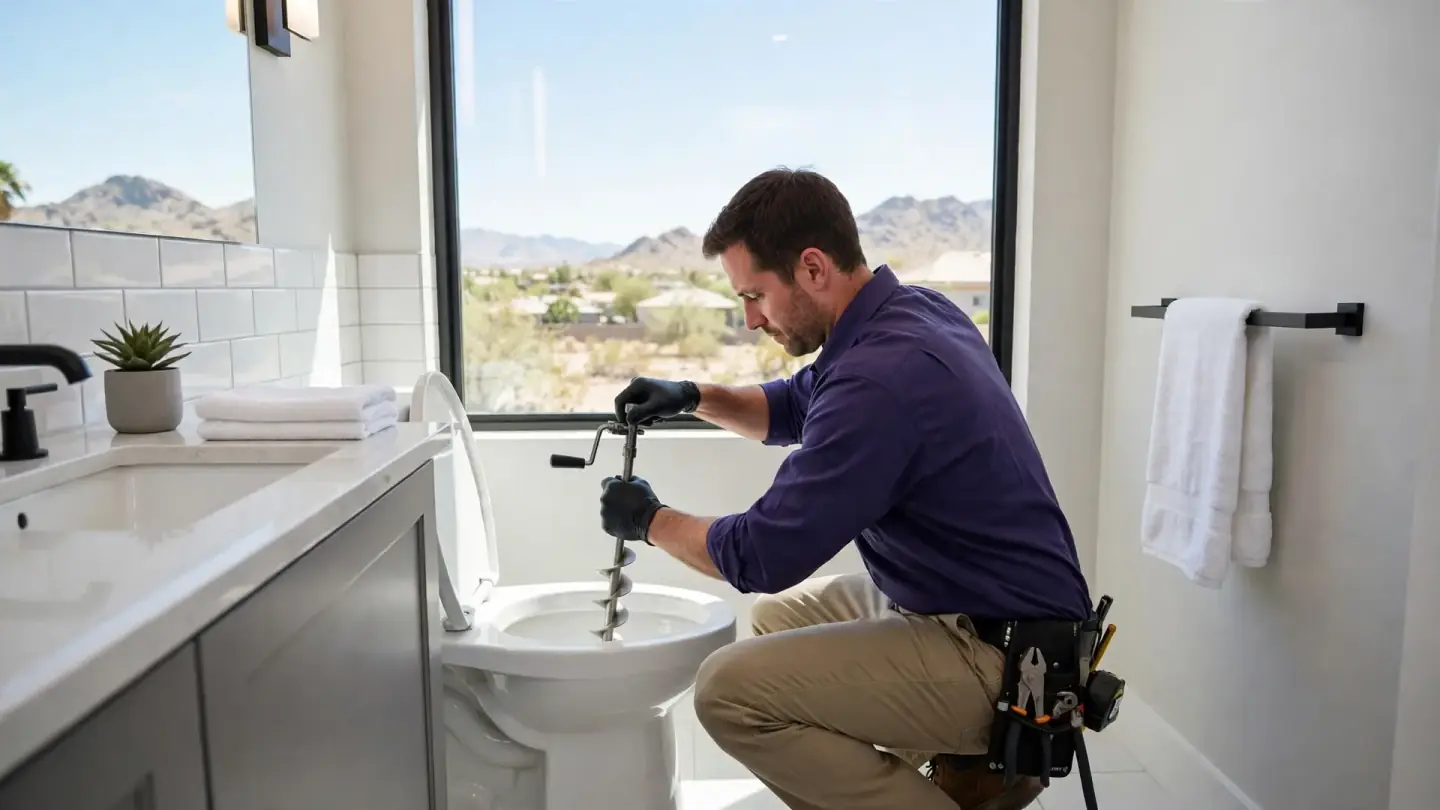
- A closet auger is a short, hand-cranked snake designed to pass through a toilet's trapway without scratching the bowl [2].
- Henderson homeowners are responsible for the private lateral that runs from the home out to the public main, where many whole-house toilet backups start [3].
- Henderson's very hard water, around 16 grains per gallon, leaves mineral deposits that can narrow small openings such as toilet rim jets [4][5].
How toilets work
Where does a toilet clog actually sit?
Under the bowl is a curved passage called the trapway. It holds the water you see in the bowl and keeps sewer gas out of the bathroom [1]. When you flush, water rushes in fast enough to start a siphon that pulls everything through that curve and down into the drain.
Most clogs lodge in that curve. It is tight, it bends twice, and anything that does not break up, like wipes, cotton pads, a child's toy or too much paper at once, can catch there. Below the toilet, a short pipe drops to the bathroom's branch line in the slab, and from there the waste heads for the main drain and the sewer lateral.
The higher up the clog, the easier the fix. The tricky part is telling which part of that path is blocked, which is what the contractor checks first.
Read the signs
Toilet symptoms and what they suggest
Bowl rises, then slowly drains
A partial clog in the trapway. Something is letting water past but blocking solids.
Weak or incomplete flush
Could be a partial clog, but also mineral buildup in the rim jets or siphon jet, or a tank that is not filling enough.
Gurgling in the bowl
Air being pulled through the water, often when another fixture drains. Points to a partial blockage or a vent problem [6].
Water on the floor at the base
Could be overflow, but a slow seep after flushing often means the wax ring under the toilet has failed.
Toilet backs up when the washer drains
The clog is in a shared line, not the toilet. This is a main-line warning sign.
Several toilets slow at once
Almost always a blockage further down: the main drain under the slab or the sewer lateral.
Do it yourself
Safe things to try before calling
- Use a flanged plungerA toilet plunger has an extra rubber sleeve that fits into the drain opening. A flat sink plunger will not seal. Push slowly first to let air out, then plunge firmly for 15 to 20 strokes.
- Keep enough water in the bowlThe plunger needs water over the cup to work. Add a little from a bucket if the bowl is low, but do not flush to add it.
- Try a closet augerIf you own one, place the curved end in the bowl outlet, crank as you push, then pull back slowly. Its rubber sleeve protects the porcelain [2].
- Remove a dropped object if you can see itWith gloves, pull out anything visible before plunging. Plunging can push a solid object deeper into the trapway.
- Give it a few minutesA paper clog sometimes softens on its own. Waiting ten minutes before trying again is reasonable.
The visit
How a contractor usually clears a toilet line
Here is the usual order of work when you call about toilet drain clearing in Henderson.
- 1
Check the other fixtures
Running the nearby sink and tub, and asking about other toilets, tells the contractor whether this is one toilet or the whole line.
- 2
Clear the trapway with a closet auger
The closet auger reaches through the curved trap and either breaks up the clog or hooks it so it can be pulled back out [2].
- 3
Pull the toilet if needed
If something solid is stuck, the toilet is shut off, drained and lifted off the floor. The object can then be pushed out from below, and the drain opening is checked.
- 4
Replace the wax ring
Any time a toilet is lifted, it is reset on a fresh wax ring or wax-free seal so it does not leak at the base.
- 5
Run the drain machine if the clog is deeper
If the toilet is clear but the line is not, a larger cable is run through the toilet flange or a cleanout to reach the branch or main line under the slab.
- 6
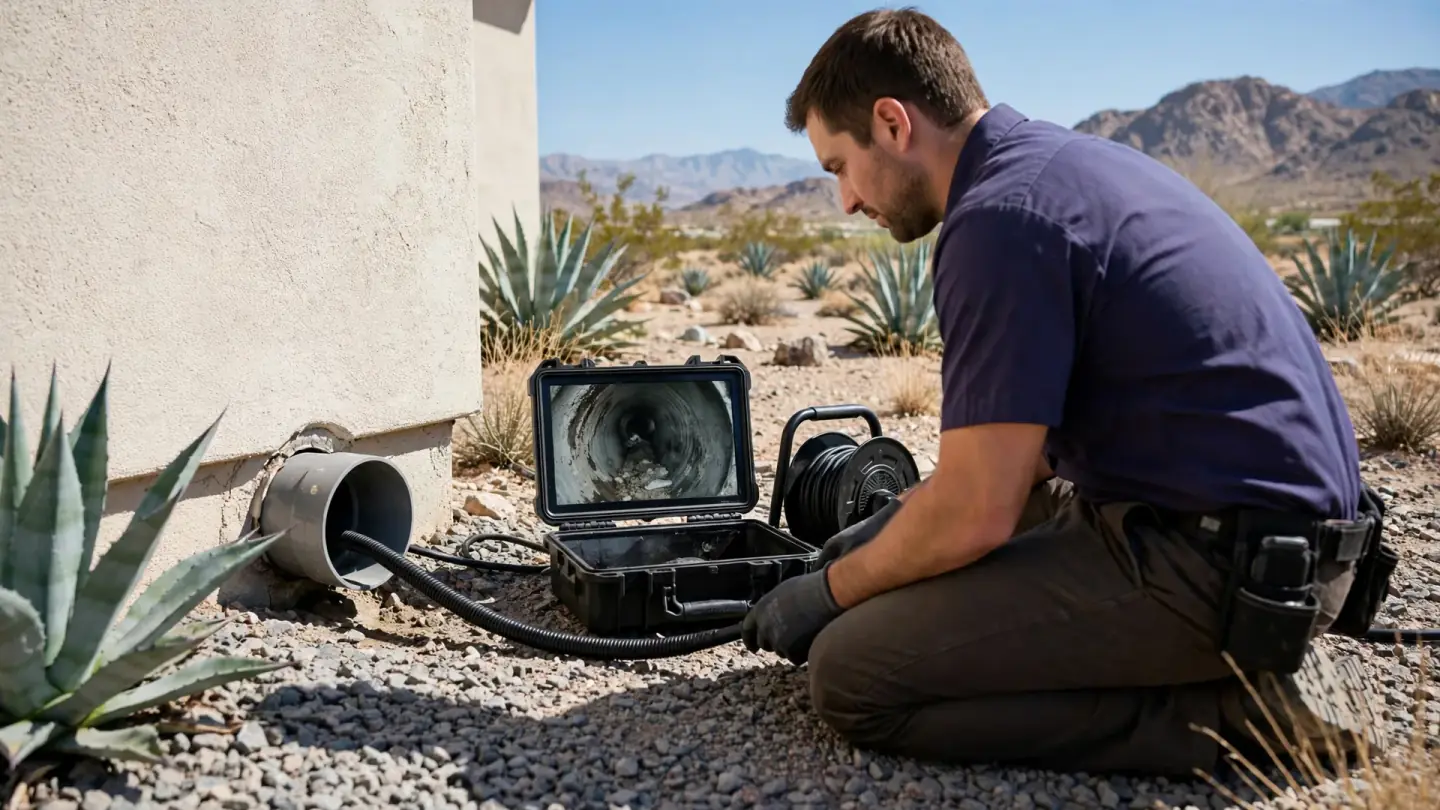
Look with a camera for repeat trouble
Toilets that keep clogging despite careful use may have a line problem. A drain camera inspection shows what is going on.
- 7
Flush test
Several full flushes with paper confirm the toilet clears properly and nothing leaks at the base.
Low-flow and modern toilets
Low-flow toilets: what changes and what does not
Many Henderson homes, especially newer ones and remodeled bathrooms, have low-water toilets. They work well, but they behave a little differently.
| Issue | Why it happens | What helps |
|---|---|---|
| Needs two flushes for solids | Less water per flush; partial clog or weak siphon | Clear the trapway; check tank fill level |
| Flush gets weaker over time | Mineral scale narrowing rim and siphon jets | Clean the jets; consider a water softener |
| Paper clogs more often | Less water to carry thick paper down the line | Use thinner paper; avoid large wads |
| Dual-flush half button leaves waste | Half flush used for solids | Use the full flush when it is needed |
A low-flow toilet that clogs constantly may not be the toilet's fault. The line beyond it can be partly blocked.
Local factors
Henderson conditions that affect toilets
Hard water is the quiet one. Henderson's supply is Colorado River water taken from Lake Mead and carries enough calcium and magnesium to reach roughly 16 grains per gallon [4], well past the 180 mg/L mark for very hard water [5]. The minerals form scale on the small holes under the rim and in the siphon jet at the bottom of the bowl [8]. A toilet with scaled jets flushes weakly and is more prone to clogs, even when the drain line is fine.
Then there is the slab. Most valley homes are built on concrete with no basement, so the toilet drain drops directly into a branch line under the floor [9]. When a clog is past the toilet, it has to be reached from the flange or a cleanout, and that is a job for a proper drain machine. See slab drain line clogs for more.
Unused toilets are a summer issue. In a hot, dry climate, the water in a guest toilet's bowl and trap can evaporate over weeks of non-use [1][10], letting sewer odor in. Flushing it every week or two keeps the seal intact.
Finally, the line to the street. If every toilet backs up, the problem may be in the sewer lateral, which Henderson homeowners are responsible for maintaining all the way to the city main [3]. See main sewer line cleaning for that situation.
Prevention
What should and should not go down a toilet
Only toilet paper and waste
Everything else, including products labeled flushable, belongs in the trash. Wipes do not break down like paper.
No cotton, floss or hygiene products
These tangle in the trapway and in the line beyond, catching paper behind them.
Keep a small trash can nearby
Guests and kids use the toilet as a bin when no can is in reach.
Clean the rim jets
Every few months, scrub under the rim with a stiff brush to keep mineral deposits from building in the jets.
Watch kids around the toilet
Toys and toothbrushes are common finds. A toilet lid lock helps with toddlers.
Book a check if clogs keep returning
Homes where toilets back up several times a year often benefit from a scheduled visit under preventative drain maintenance, which can catch a narrowing line before it stops.
Urgent cases
When is a toilet clog an emergency?
A single clogged toilet with a working second bathroom can usually wait for a convenient appointment. It is a different situation when the only toilet in the home is out of action, when the bowl overflows with each attempt, or when sewage appears in a tub, shower or floor drain.
For those, see emergency toilet drain cleaning. Call to check emergency availability, keep water use to a minimum, and keep everyone away from any overflow until it has been cleaned up properly.
FAQ
Toilet clog questions Henderson homeowners ask
Short answers on toilet drain clearing. The [quick-answer page](/faq/) covers the rest. Back to [Henderson drain services](/services/).
Are flushable wipes actually safe to flush in a Henderson home?
Flushable wipes are usually not safe to flush, because they do not break apart as quickly as toilet paper and can snag in the trap or sewer lateral. Henderson homeowners are responsible for the lateral to the city main [3]. Putting wipes in the trash is the simplest way to avoid toilet and main line clogs.
Is a toilet that rocks and leaks at the base clogged?
A toilet that rocks and leaks at the base usually has a failing wax ring or loose flange rather than a clog. Leaking water can damage flooring. If the toilet is also slow to flush, there may be a clog too, so ask the contractor you're connected with to check both.
Why does my low-flow toilet clog more than my old toilet?
A low-flow toilet may clog more than an older model if its design moves less water through the trapway, especially with heavy paper use. Hard water deposits can also narrow rim jets [4][5]. Cleaning the rim jets and using less paper per flush often helps a great deal.
Can I use a regular sink snake on a clogged toilet?
A regular sink snake is usually not the right tool for a clogged toilet, because it can scratch the bowl and struggle with the trapway's curve. A closet auger is a short hand-cranked snake designed for toilets [2]. If a closet auger does not clear it, the clog may sit further down the line or in the main.
When is a clogged toilet actually a main sewer line problem?
A clogged toilet is often a main sewer line problem when other drains also back up, gurgle or slow down, or when flushing makes water rise in a tub or shower. Many whole-house toilet backups start in the lateral, which the homeowner owns [3]. Call to have the main line checked.
Will clearing a toilet clog mean taking the toilet off the floor?
Clearing a toilet clog usually does not mean taking the toilet off the floor; most clogs are cleared with a plunger or closet auger. Removal is generally needed only when an object is lodged deep in the trapway or the clog is just past the flange. The contractor can explain if removal is likely.
What causes a toilet bowl to bubble while the sink is running?
A toilet that gurgles when you run the bathroom sink usually means air is being pulled through its trap because the shared drain or vent is partly blocked. Drain-waste-vent systems need air behind draining water [6]. If gurgling spreads to other fixtures, the main line may also be involved.
How do I unclog a toilet without making it overflow?
Unclogging a toilet safely starts with not flushing again. Close the supply valve behind the toilet or lift the flapper so no more water enters, then use a flange plunger with slow, firm strokes, keeping the cup sealed under water. If several tries fail, or other drains react when you plunge, stop and have the line cleared with a closet auger.
Sources and citations
- [1]Wikipedia: Trap (plumbing)
- [2]Wikipedia: Plumber's snake
- [3]City of Henderson: Water and sewer laterals
- [4]City of Henderson 2024 Water Quality Report
- [5]USGS: Water hardness FAQ
- [6]Wikipedia: Drain-waste-vent system
- [7]Wikipedia: Drain cleaner
- [8]Wikipedia: Hard water
- [9]Las Vegas Advisor: Why Las Vegas houses don't have basements
- [10]Wikipedia: Henderson, Nevada