
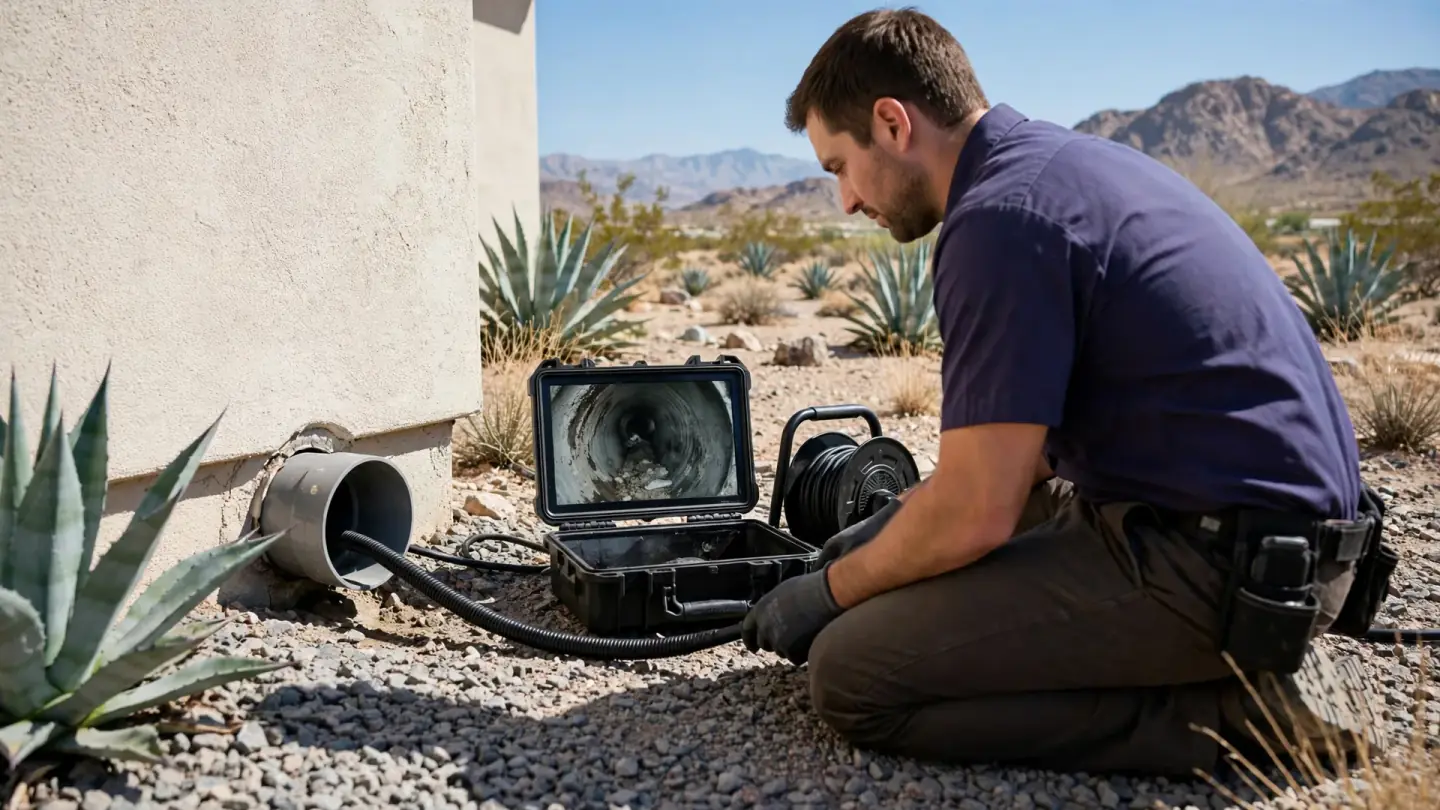
Key facts: Slab drain line clogs
- Basements are uncommon across the Las Vegas Valley; most homes are slab-on-grade, so drain lines run under or within the slab [1].
- Hard, cemented calcium-carbonate soil called caliche is common under the valley and makes digging difficult [2].
- Henderson homeowners are responsible for the building sewer between the house and the street main [3].
- Cable augers and water jetting are the main mechanical ways to clear buried drain lines [4][5].
Quick answer
What counts as a slab line clog?
It is any blockage in the pipes buried beneath your floor rather than in the trap or tailpiece you can see under a sink. In a slab-on-grade home, that covers the branch lines linking bathrooms and the kitchen, plus the building drain that carries everything out to the yard.
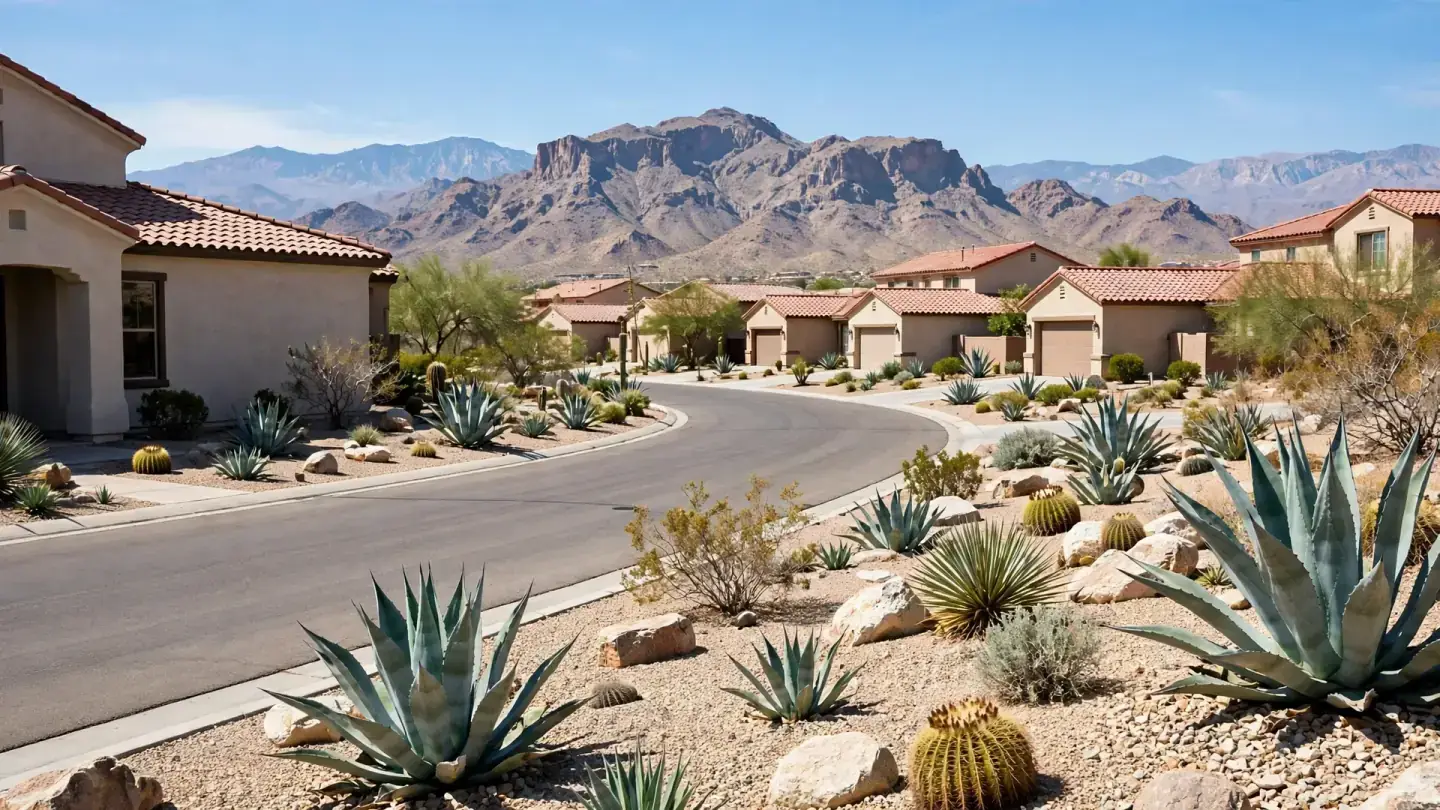
Henderson builds this way for good reason. Basements are uncommon across the valley, partly because hard, cemented caliche soil makes deep digging tough [1][2]. So instead of hanging under joists, the pipes are set in the ground and the slab is poured over them.
Most slab drain line clogs are ordinary clogs in an awkward place: grease, wipes, hair, scale. They feel more serious because you cannot get to them with a plunger.
Layout
How the pipes run in a typical slab home
Picture a tree laid flat. Each fixture has its own trap and a short arm that drops into the slab. Those arms join branch lines, the branches join a main building drain, and that drain leaves the foundation toward the street.
Past the foundation, the pipe becomes your sewer lateral. The City of Henderson's guidance is clear that the homeowner maintains that lateral all the way to the city main; Utility Services looks after the main itself [3].
Cleanouts are capped openings placed so a cable can be fed into the system. You may find one outside near the foundation, in the yard, or in a garage wall.
- Fixture trap and arm: inside the wall or cabinet
- Branch lines: beneath the slab
- Building drain: beneath the slab to the foundation edge
- Lateral: yard to city main, homeowner-maintained
Warning signs
Clues the clog is below the floor
Two nearby fixtures slow together
A tub and toilet in the same bathroom both backing up points to the branch line they share.
Water shows up in an odd drain
Running the washer and seeing water rise in a shower is a classic sign of a blockage downstream of both.
Plunging helps for a day, then fails
A plunger can push a slab clog back a little, but it cannot break it up.
Gurgles from a fixture you are not using
Air being pushed through a trap means water is struggling to move past something further along.
Damp floor or warm spot
Rare, but a persistent damp patch can mean a leak in a buried line rather than a simple clog. Have it checked.
Where is the blockage?
Narrowing down the location
| Fixtures affected | Most likely spot | Typical approach |
|---|---|---|
| One sink or one shower | Trap or fixture arm | Hand tools; see the room-specific services |
| Everything in one bathroom | Bathroom branch under the slab | Cable from a cleanout or through the toilet flange |
| Kitchen plus laundry | Shared kitchen branch | Cable or jetting to clear grease |
| Every drain in the house | Building drain or lateral | Cleanout access; often followed by a camera check |
Causes
What actually builds up in a slab drain line?
Kitchen grease is the big one for branch lines. It flows out warm, cools in the buried pipe and sticks. Scraps, rice and coffee grounds lodge in it. Our list of things to keep out of drains covers the usual culprits.
Mineral scale is the Henderson twist. The city's water is very hard, with hardness around 16 grains per gallon [6], and that crust lines buried pipes just as it does fixtures. A narrower pipe clogs sooner.
Wipes and paper products are the third common cause, especially in lines with a long, gently sloped run. They slow down, settle and catch everything that follows.
How pros reach it
Clearing a slab clog without breaking concrete
- 1
Find the right access point
The contractor looks for the cleanout closest to the problem, or pulls a toilet to reach the branch through its floor opening.
- 2
Run a cable
A motorized auger feeds a spinning cable through the line to break up the blockage [4]. This is usually where clogged drain repair starts.
- 3
Jet if buildup is heavy
For grease or scale coating long runs, hydro-jetting uses high-pressure water to scour the full pipe wall [5].
- 4
Look inside
A drain camera inspection confirms the line is clear and checks for sags, cracks or offset joints.
- 5
Talk through what was found
If the camera shows damage, the contractor can explain repair options. Breaking into the slab is a last resort, not the first step.
Before help arrives
What you can safely do in the meantime
Stop running water in the affected area. Every flush or load of laundry adds to what is already stuck, and in a slab home that water has nowhere to go except back up through the lowest fixture.
If you know where your outdoor cleanout is, clear any gravel or plants away from the cap so the contractor can reach it quickly. Do not unscrew the cap yourself when the line is full; built-up wastewater can spill out with some force.
Skip the chemical bottle. Products poured into a sink rarely travel far enough to reach slab drain line clogs, and they leave caustic water sitting in the pipe for whoever opens it next [5]. A quick note of which fixtures are slow, and since when, will help far more.
Prevention
Keeping buried lines clear
- Wipe pans out with a paper towel before they go in the sink them.
- Flush only toilet paper, even with wipes labeled flushable.
- Use strainers in every tub, shower and kitchen basin.
- Know where your cleanouts are and keep them uncovered by gravel or planters.
- Book periodic preventative drain maintenance if one branch has clogged more than once.
FAQ
Slab drain line questions from Henderson homeowners
Short answers on slab drain line clogs. The [drain FAQ hub](/faq/) covers the rest. Back to [all drain guides](/guides/).
Why don't Henderson homes have basements for reaching drain pipes?
Henderson homes rarely have basements because most of the Las Vegas Valley is built slab-on-grade, partly due to hard cemented soil [1][2]. That cemented layer, called caliche, makes deep digging difficult. As a result, drain pipes usually run below or within the concrete slab, and clogs there are reached through cleanouts rather than from an open crawlspace.
How does a contractor clear a clog under a concrete slab without breaking it?
Slab drain clogs are usually cleared from a cleanout or fixture opening using a cable auger or water jetting, with no concrete removed [4][5]. The equipment travels through the existing pipe to reach the blockage. Breaking the slab is generally a last resort, considered only when a camera shows the pipe itself is damaged rather than simply blocked.
What does caliche soil have to do with slab drain repairs in Henderson?
Caliche is a hard, cemented calcium-carbonate soil common under the Las Vegas Valley, and it makes excavation slow and difficult [2]. That's one reason contractors in Henderson try hard to clear slab drain clogs from inside the pipe. Any repair that does require digging tends to involve more planning, so understanding the clog with a camera first is often sensible.
Can a slab drain clog cause water to show up on my floors?
A slab drain clog usually shows up as backups at fixtures rather than water seeping through the floor. Water appearing on flooring with no fixture overflowing may point to a leak rather than a clog, which needs a different diagnosis. Mention exactly where the water appears when you call, so the contractor you're connected with can plan the right inspection.
Do I need a permit to repair a drain line under my slab in Henderson?
Repairs that replace or reroute drain piping under a slab may fall under the plumbing code Henderson adopts, the Uniform Plumbing Code [7]. Simple clearing of a clog normally doesn't involve permits. If a camera shows a broken pipe needing repair, ask the contractor you're connected with how permits apply to that specific job before work starts.
Which slab drain usually backs up first in a single-story Henderson house?
The lowest drain in a single-story slab home, often a shower, tub or toilet, typically backs up first when a buried line clogs [1]. Water seeks the lowest open fixture. If that low fixture fills while you run water elsewhere, the blockage is probably in a shared section under the slab or in the lateral running to the street [3].
Is hydro jetting or a cable better for clogs buried under a slab?
Hydro jetting and cable augers both reach clogs buried beneath a slab, and the choice usually depends on what's causing the blockage [4][5]. Cables are often used to punch through a solid obstruction, while jetting scours grease and scale along the pipe walls. Many contractors use a camera first, then choose the method that fits the line's condition.
Sources and citations
- [1]Las Vegas Advisor: Why Las Vegas houses don't have basements
- [2]UNLV: Engineering with heavily cemented soils in Las Vegas
- [3]City of Henderson: Water and sewer laterals
- [4]Wikipedia: Plumber's snake
- [5]Wikipedia: Drain cleaner
- [6]City of Henderson 2024 Water Quality Report
- [7]City of Henderson: Uniform Plumbing Code