Key facts: Hydro Jetting
- Hydro jetting is a mechanical drain-cleaning method that uses high-pressure water rather than chemicals to clear pipes [1].
- Henderson's water is hard, at close to 16 grains per gallon, because it carries calcium and magnesium picked up from the Colorado River and Lake Mead [3].
- Hard water leaves calcium and magnesium carbonate scale on surfaces, and more of it forms when water is heated [4].
- The USGS classifies water above 180 mg/L as calcium carbonate as very hard [5].
The method
What is hydro jetting?
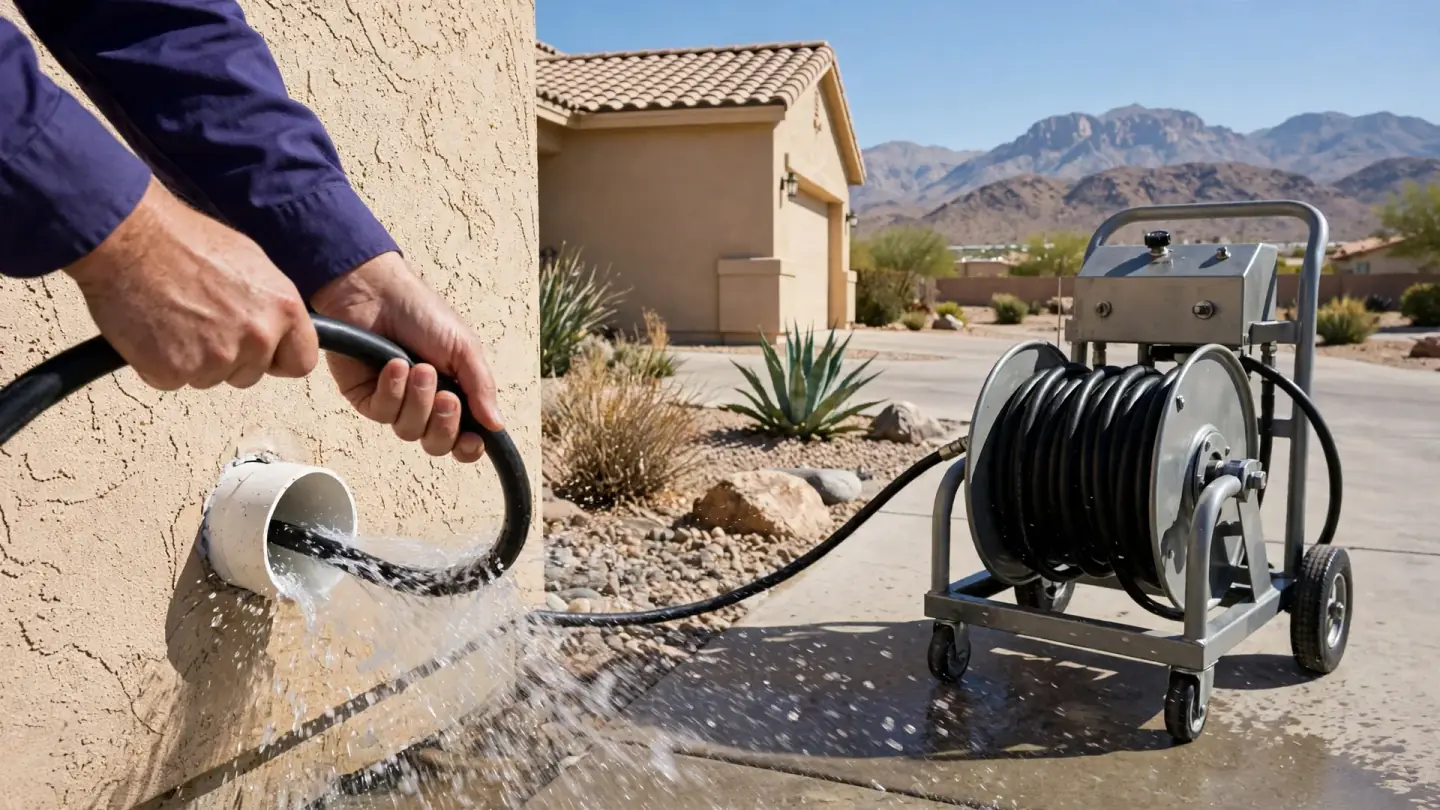
A jetting machine pumps water through a tough, flexible hose. At the end of the hose is a nozzle with small openings. Most of them point backward, and one or more may point forward.
The backward jets do two jobs at once. They pull the hose deeper into the pipe, and they blast the pipe wall all the way around as the hose travels. The forward jet breaks into whatever is blocking the line ahead.
As the contractor slowly pulls the hose back, the water scours the inside of the pipe and flushes the loosened material downstream toward the sewer main. Drain cleaning references group water jetting with mechanical methods like cables, as opposed to chemical cleaners [1].
The result is not just a hole through the clog. When it goes well, the pipe wall itself is cleaned close to its original diameter.
Choosing a tool
Jetting compared with a drain cable
A drain cable, also called a snake or auger, is a rotating steel cable with a cutting head [2]. Both tools have a place.
| Question | Drain cable | Hydro jetting |
|---|---|---|
| How it clears | Bores or hooks through the blockage | Washes the blockage and pipe wall with pressurized water |
| Best for | Paper, wipes, hair, soft single clogs | Grease, sludge, soap buildup, mineral scale |
| Pipe wall afterward | Often still coated | Usually much cleaner |
| Repeat clogs | May return if buildup remains | Less likely when buildup was the cause |
| Fragile or broken pipe | Often the safer first choice | May not be suitable until the pipe is checked |
| Setup | Smaller machine, quick setup | Larger equipment and a water supply |
Good fits
When a water jet is usually the better choice
Grease in kitchen lines
Fat and oil cling to pipe walls and harden. A cable may poke through, but the jet removes the coating itself.
Lines that keep re-clogging
If a drain has been snaked more than once in a short time, buildup on the wall is often the real issue.
Heavy mineral scale
Hard-water deposits narrow a pipe slowly. Jetting with the right nozzle can scour much of it away.
Restaurant and commercial lines
Busy kitchens send grease, food solids and detergent through their drains every day, and buildup forms fast.
Sludge in long runs
Long main lines collect a layer of settled material along the bottom that a jet can flush out.
Before a camera inspection
A clean pipe gives a much clearer picture, so jetting is sometimes done to prepare for filming.
Hard water
Why Henderson's water makes jetting relevant
All of Henderson's water originates in the Colorado River and is drawn from Lake Mead, and along the way it picks up calcium and magnesium. The city puts its hardness at some 16 grains per gallon [3]. That is well above 180 mg/L, the line the U.S. Geological Survey uses to define very hard water [5].
Hard water leaves carbonate scale on surfaces it touches, and heating makes the effect stronger [4]. Inside drain lines, that scale is often mixed with soap residue, grease and hair. Together they form a rough, stubborn layer that narrows the opening over the years.
A cable can carve a path through that layer, but much of it stays put. That is one reason many contractors suggest hydro jetting henderson homes with long-term buildup, especially in kitchen lines and main lines that clog again soon after cleaning.
For more on how scale forms, see the hard water scale guide.
How it goes
A typical jetting visit, step by step
- 1
Understand the problem
The contractor asks which drains are slow, how often they clog and what has been tried. This helps decide whether jetting is the right fit.
- 2
Check the pipe if needed
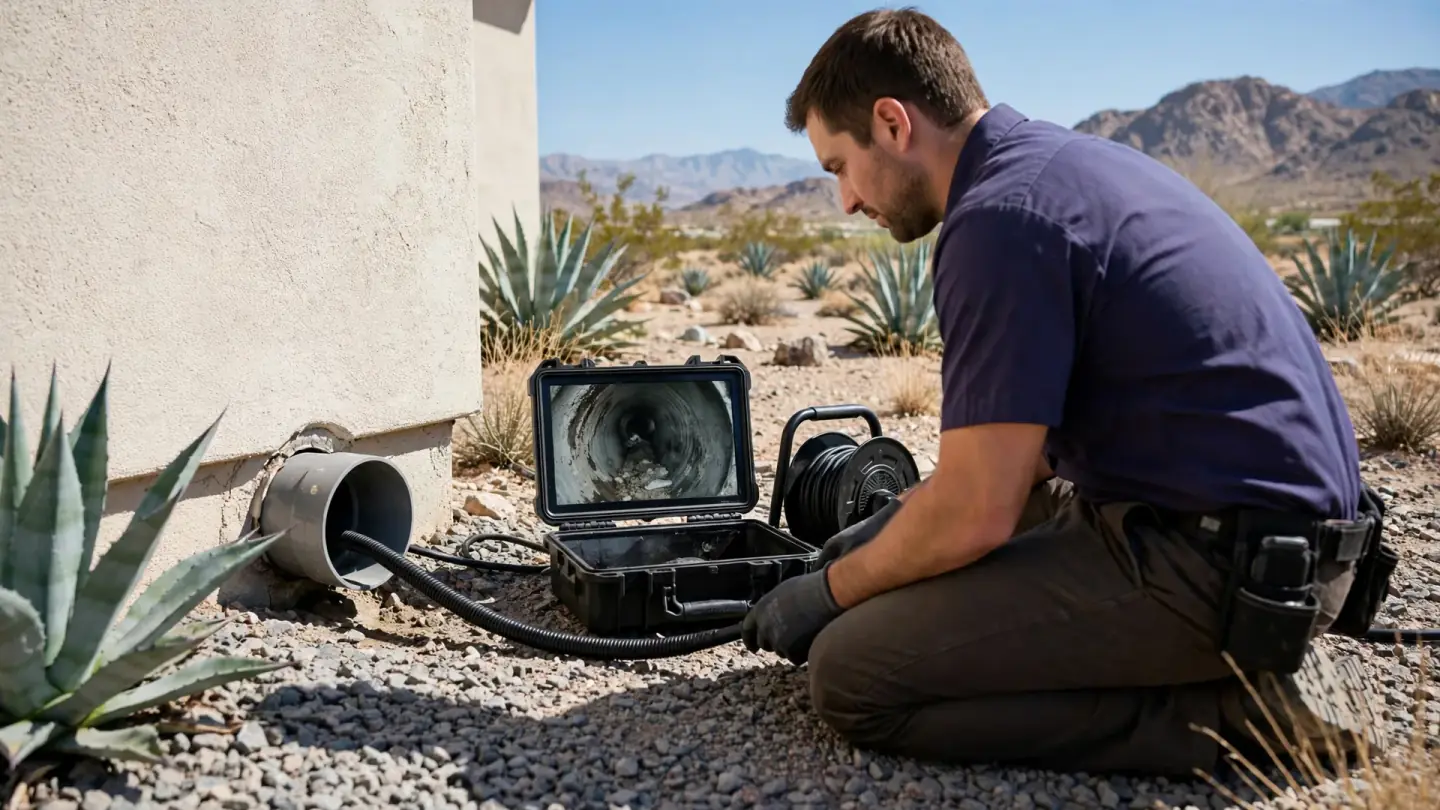
For older or uncertain lines, many contractors run a camera first. Jetting is not a good match for a pipe that is already broken or badly separated.
- 3
Pick the access point
Usually an outdoor cleanout for a main line, or a cleanout or opening near the fixture for a branch line.
- 4
Choose the nozzle
Different nozzles suit different jobs: a penetrating head for blockages, a rotating head for scale, and others for grease.
- 5
Jet in passes
The hose is advanced and pulled back in sections, flushing debris toward the city main. The contractor watches how the water flows back.
- 6
Confirm the line is clean
A test flush, and often a camera pass, shows whether the pipe is clear and how much buildup remains.
Not always the answer
When a cable or other method makes more sense
Jetting is a powerful tool, but it is not the right first move every time. A single clog of paper or a toy in a toilet line is usually handled faster with a cable.
If a pipe is cracked, crushed or separated, high-pressure water may make things worse or simply flow out into the soil. That is why a camera look first is sensible on older lines and after repeat problems.
Small interior drains, such as a single bathroom sink, are often better served by hand tools or a small machine. For those, see bathroom drain cleaning.
- Unknown pipe condition: inspect first
- Simple soft clog: cable is usually enough
- Grease or scale: jetting is often the better fit
Grease
Grease, food businesses and fatbergs
Grease is the classic job for a jet. Fats and oils cool in the pipe, harden and combine with other waste. On a large scale, this is how fatbergs form in public sewers [7].
Restaurants and other food businesses use grease traps or interceptors to catch fats before they enter the sewer [6]. Those devices need regular pumping, but the lines leading to and from them can still build up a coating that jetting removes.
If you run a food business, our commercial drain cleaning page explains Henderson's grease interceptor rules and how contractors schedule around service hours.
Afterward
Helping a freshly jetted line stay clean
Jetting resets a pipe, but daily habits decide how quickly buildup comes back. These simple steps help.
- Keep grease out of the sinkLet pan drippings cool, wipe them into the trash with a paper towel and then wash the pan. Our guide on what not to pour down drains lists other common culprits.
- Use strainersSimple mesh strainers in kitchen and shower drains catch food scraps and hair before they reach the pipe.
- Follow up with regular hot-water rinsesAfter greasy dishes, running hot water for a short while helps carry residue further along instead of letting it settle close to the sink.
- Skip the wipesEven products labeled flushable tend to snag on any remaining roughness inside the line.
- Watch for early signsA drain that starts slowing again within weeks is worth mentioning to the contractor. It may point to damage or a sag the camera should look at.
Homes and businesses
Who in Henderson tends to call about jetting
Homeowners in established neighborhoods are a common group. Many homes in areas such as Green Valley have been in use for decades, and their kitchen and main lines have had years of hard water and cooking grease passing through them.
Owners of rental homes and multi-unit buildings are another. Different tenants have different habits, and shared lines can collect buildup from several households at once.
Food businesses are the third. Kitchens that cook all day push a steady stream of fat, starch and detergent into their drains. For them, jetting is often part of a regular routine rather than a one-off fix.
Whoever you are, the starting point is the same: a clear description of what your drains are doing, so the contractor can judge whether a water jet fits the problem.
Be prepared
Questions to ask before agreeing to jetting
- Why do you recommend jetting rather than a cable for my line?
- Will you inspect the pipe with a camera before or after?
- Which access point will you use, and will anything inside the house be affected?
- What nozzle do you plan to use for this kind of buildup?
- Is my line in good enough condition for high-pressure water?
- What can I do afterward to slow down future buildup?
Ownership and repairs
Your lateral, the city main and any follow-up work
In Henderson, the sewer lateral from your house to the main in the street is the property owner's responsibility, while the city maintains the main [8]. Jetting your own line is private work you arrange.
If jetting or a camera shows damage, the conversation may turn to repairs. Digging in the valley's cemented caliche soil is slow and hard work [9], so contractors generally look at every option before excavating.
Henderson follows the 2024 Uniform Plumbing Code as amended for Southern Nevada, and permit applications go through Building and Fire Safety [10]. The contractor can confirm if a permit is required to any repair you choose.
FAQ
Hydro jetting questions Henderson property owners ask
Short answers on hydro jetting. The [master FAQ](/faq/) covers the rest. Back to [the services overview](/services/).
Is hydro jetting safe for older cast iron or clay sewer pipes?
Hydro jetting is usually safe for older cast iron or clay pipes in sound condition, but badly cracked or corroded sections can be damaged by high pressure. That is why many contractors run a camera first to check pipe condition. Jetting cleans with water rather than chemicals [1], and the pressure is typically adjusted to suit the pipe.
Can hydro jetting remove hard water scale from Henderson drain lines?
Hydro jetting can often remove softer hard water scale from drain lines, though very thick, hardened deposits may need a specialized nozzle or several passes. Henderson's water is roughly 16 grains per gallon [3], and scale forms faster where water is heated [4]. Jetting washes the full pipe wall, which a cable usually cannot do.
Does hydro jetting make a mess inside the house?
Hydro jetting usually does not make a mess inside the house, because the hose typically enters through an outdoor cleanout and the water flows down the line toward the sewer. Indoor jetting through a fixture or cleanout is sometimes needed, and contractors normally protect floors. Ask the local drain company where they plan to access the line.
How long does a typical residential hydro jetting job take?
A typical residential hydro jetting job often takes one to a few hours, depending on line length, how much grease or scale is present, and how easy the cleanout is to reach. Adding a camera inspection before or after extends the visit. The contractor you're connected with can give a rough timeframe once they see the access point.
When should I choose hydro jetting instead of snaking a drain?
Hydro jetting is usually chosen over snaking when grease, sludge or scale coats the whole pipe, or when a line keeps clogging after cable cleaning. A snake punches through a blockage [2], while jetting scours the pipe wall. For a single hair or paper clog close to a fixture, a simple snake is often enough.
Can hydro jetting cut through tree roots in a sewer lateral?
Hydro jetting with a root-cutting nozzle can often clear fine tree roots from a sewer lateral, though thick roots may need a mechanical cutter first. Roots usually enter through cracks or loose joints, so a camera look afterward helps show whether repair is needed. Henderson homeowners are responsible for the lateral to the city main [8].
How often should a restaurant line be hydro jetted?
Restaurant line hydro jetting frequency varies with menu and volume, but many kitchens schedule it periodically to keep grease from hardening into solid masses [7]. Jetting complements, rather than replaces, grease interceptor maintenance [6]. A camera check after the first jetting usually shows how fast buildup returns, which helps set a realistic schedule.
Sources and citations
- [1]Wikipedia: Drain cleaner
- [2]Wikipedia: Plumber's snake
- [3]City of Henderson 2024 Water Quality Report
- [4]Wikipedia: Hard water
- [5]USGS: Water hardness FAQ
- [6]Wikipedia: Grease trap
- [7]Wikipedia: Fatberg
- [8]City of Henderson: Water and sewer laterals
- [9]UNLV: Engineering with heavily cemented soils in Las Vegas
- [10]City of Henderson: Uniform Plumbing Code