
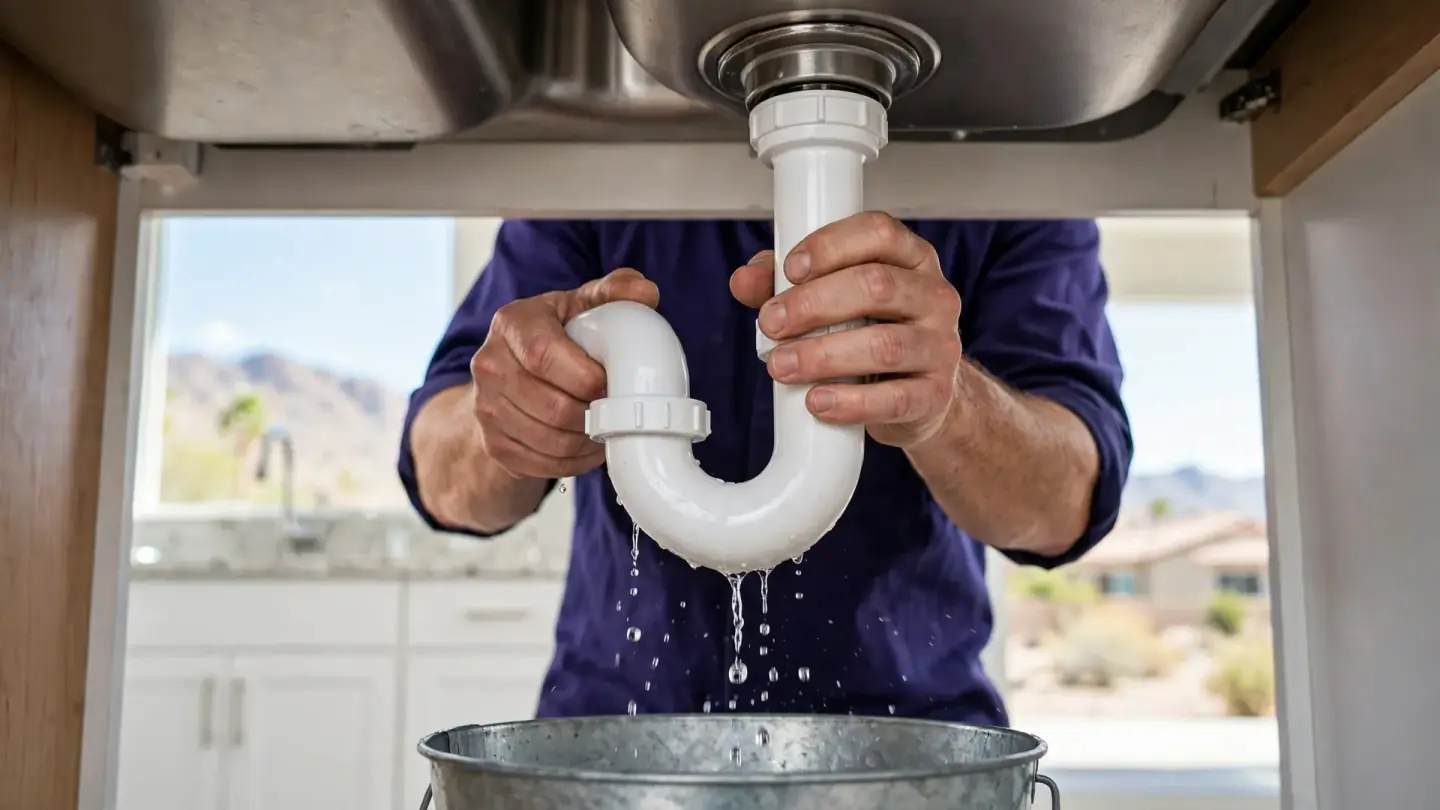
Key facts: Garbage disposal dos and don'ts
- A disposal spins a turntable that throws food against a grind ring until pieces are small enough to pass through [1].
- Hard objects such as metal cutlery can damage a disposal [1].
- Food waste from disposals adds organic load to the sewer and treatment plant [1].
- Henderson's pretreatment program targets fats, oils and grease that block sewers [2].
Short answer
What is a disposal really built to handle?
A disposal is a grinder, not a dissolver. A motor spins a plate inside the chamber, and small impellers fling food against a grind ring until the pieces pass through its openings [1]. Soft scraps like cooked vegetables, small bits of fruit and plate leftovers suit it well.
Problems start when people treat it like a second trash can. Grease passes through as liquid but solidifies further down. Stringy and fibrous peels wrap around the parts. Starchy foods turn to paste. Hard objects jam or damage it [1].
This guide is about everyday use. If a kitchen sink is already full and won't drain, see emergency kitchen drain cleaning. For the full list of things to keep out of every drain in the house, read what not to pour down drains.
Symptom check
Disposal symptoms and first responses
| What you see | Likely cause | What to do |
|---|---|---|
| Hums but doesn't spin | Jammed turntable | Power off, free it with the hex key underneath |
| Silent, no hum | Tripped reset button or breaker | Press the reset on the bottom, check the breaker |
| Grinds but sink drains slowly | Clog in the trap or line past the disposal | Stop grinding; plunge or call |
| Water backs up into the other basin | Blockage in the shared kitchen drain | Don't run the disposal; call if it persists |
| Leak under the sink | Loose connection or cracked housing | Turn off power and water to that area; call |
The dos
Habits that keep a disposal and drain healthy
- Run cold water throughoutStart the tap before grinding and keep it going for a short while after, so particles are carried well down the line.
- Feed scraps graduallyA handful at a time grinds cleaner than a full chamber.
- Scrape plates into the trash firstSend only the small leftovers to the disposal.
- Use it regularlyShort, regular use keeps parts moving and stops scraps from sitting in the chamber.
- Clean the splash guardThe rubber flaps collect grime; scrub them with dish soap and a brush.
The don'ts
What stays out of the disposal
- Grease, oil and fatThey harden in the line and bind with food solids; sewer blockages from fats are a known problem [2][3].
- Fibrous peels and husksCelery strings, corn husks and onion skins can wrap around the parts.
- Pasta, rice and potato peels in bulkStarchy scraps swell and form a paste in the trap.
- Bones, pits and shellsHard items strain the grinder and may jam it.
- Utensils and bottle capsMetal objects can damage the unit [1]; check the chamber before switching on.
- Chemical drain openersCaustic products sitting in a disposal are a splash hazard for whoever clears it [4].
Safe checks
Freeing a jammed disposal safely
- 1
Cut the power
Switch it off at the wall switch and, if you can, at the breaker. Never put a hand in the chamber.
- 2
Look with a flashlight
Spot anything solid, then remove it with tongs or pliers.
- 3
Turn the flywheel from below
Many units have a hex socket in the bottom center. Work the key back and forth until it turns freely.
- 4
Press reset
Push the red reset button on the bottom of the unit, restore power and test with cold water running.
- 5
Stop if water stays in the sink
If the unit spins but the sink won't drain, the clog is further down. Don't keep grinding into it.
Cause in depth
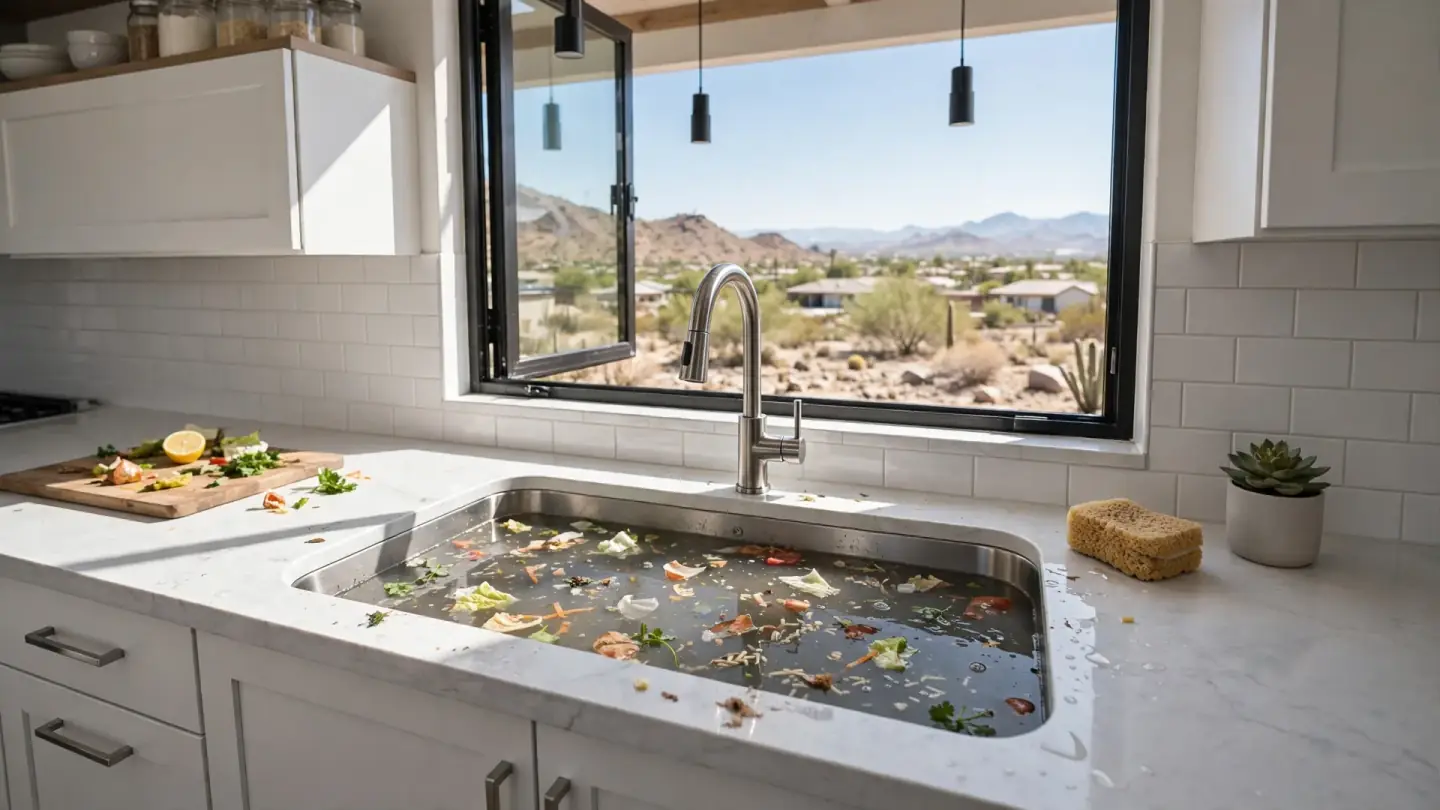
Why disposal clogs often show up further down
Ground food is fine enough to leave the disposal, but it still has to travel through the trap and the kitchen branch. If grease is already coating that pipe, the particles stick to it and slowly build a plug. In Henderson, hard water scale on the pipe wall gives that buildup an even better grip.
Grease buildup of this kind is the household version of what cities call FOG, and Henderson runs a pretreatment program aimed at keeping fats, oils and grease out of the sewer [2]. In extreme cases across the world, this kind of buildup forms huge masses in sewers [3].
Prevention
Keeping the kitchen line clear with a disposal
- Wipe greasy pans with a paper towel before washing.
- Collect cooled fat in a can and put it in the trash.
- Run cold water fully through each use.
- Keep a strainer in the second basin to catch what shouldn't go down.
- If you've just moved into a new build, read kitchen sink clogs in new construction.
Before you call
What to tell the pro about your disposal
- Whether the unit hums, spins or stays silent.
- What went down just before the trouble.
- Whether one or both basins are holding water.
- Any drain product already used.
- Whether the dishwasher drains through the disposal.
FAQ
Disposal questions Henderson cooks ask
Everyday disposal answers; more on the [questions hub](/faq/). Back to [all guides](/guides/).
Should I run hot or cold water with the garbage disposal?
Cold water is the usual advice while running a garbage disposal, because it keeps any fat solid enough to be ground and carried away rather than melting and coating the pipe. Run it before, during and for a short time after grinding.
Can I put eggshells down the garbage disposal?
Eggshells are best kept out of the garbage disposal. The thin membrane can wrap around parts, and the gritty shell fragments can settle in the trap with other scraps. Put them in the trash or compost instead.
Why does my disposal hum but not turn?
A disposal that hums without turning is usually jammed. Switch off the power, look for a hard object and remove it with tongs, then turn the flywheel with the hex key in the bottom of the unit. Press reset and test with cold water running.
Is it bad to pour bacon grease down the disposal with hot water?
Pouring bacon grease down the disposal is bad even with hot water, because the grease cools and hardens further along the line. It then traps food particles and narrows the pipe. Henderson's pretreatment rules exist because fats block sewers [2].
How do I get rid of a bad smell coming from my disposal?
A smelly disposal usually has food stuck under the splash guard or on the grind chamber walls. With the power off, scrub the rubber flaps with dish soap and a brush. Grinding a few ice cubes can knock off residue. If the smell persists, the trap may need cleaning.
Can a disposal clog the main sewer line?
A disposal can contribute to a main line clog when ground food meets grease, roots or scale downstream. Most disposal clogs stay in the kitchen branch, but if several fixtures back up, the problem is further down. Stop using water and call.