
Key facts: Kitchen sink clogs in new construction
- Henderson's population grew by about a quarter between the last two censuses, much of it in newer master-planned areas [1].
- Inspirada, a large south Henderson community, resumed home building after the late-2000s downturn [2].
- Hard objects can damage a garbage disposal, and disposals add food solids to the drain [3].
- Chemical drain openers are caustic or acidic and can be dangerous to mix [4].
Short answer
Why would a brand-new kitchen drain clog so soon?
New pipes are smooth and wide open, so an early clog usually has a specific cause. The common ones are construction leftovers in the line, such as grout, joint compound, caulk or packaging; installation details, like a dishwasher hose or disposal connection set up in a way that lets food settle; and the first weeks of a household's habits, especially grease and starchy scraps going into a disposal.
Henderson has been building fast. The city's population grew by roughly a quarter between the last two censuses [1], and large communities like Inspirada came back to life after the late-2000s slowdown [2]. That means plenty of households are living with kitchens that are only months old.
This guide is about that early-life clog. For everyday disposal use, see garbage disposal dos and don'ts. For a sink full right now, see emergency kitchen drain cleaning.
Symptom check
New-kitchen drain symptoms and next steps
| What you see | Likely cause | What to do |
|---|---|---|
| Sink slow from the first week | Construction debris in the trap or branch | Check the trap; tell the builder |
| Dishwasher leaves water in the sink | Hose routing or a knockout plug left in the disposal | Ask the builder or installer to check |
| Gritty, chalky bits come up | Grout, drywall mud or thinset in the line | Don't use chemicals; call |
| Disposal side drains, other side doesn't | Clog in the second basin's tailpiece or trap | Plunge with the other side sealed |
| Gurgling with no visible clog | Venting issue or partial blockage | Report to the builder |
Safe checks
Simple checks under a new sink
- 1
Look at the trap
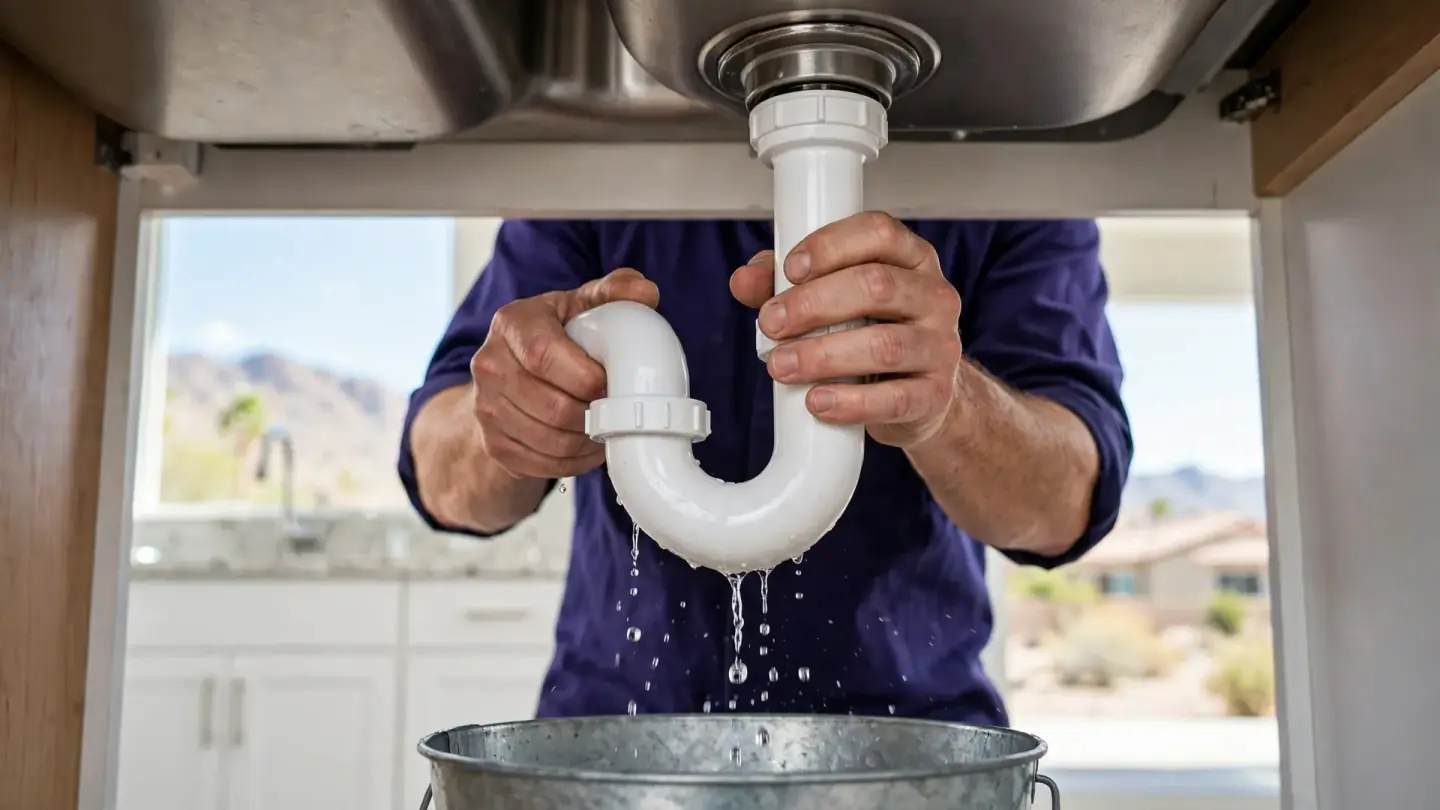
With a bucket under it, loosen the slip nuts by hand and check the trap for debris. New fittings usually loosen easily.
- 2
Check the dishwasher hose
The hose should loop up high under the counter or connect through an air gap, not sag to the floor of the cabinet.
- 3
Test the disposal
Run it with cold water and listen. If the dishwasher drains poorly, ask whether the disposal's knockout plug was removed when it was connected.
- 4
Plunge with the second basin sealed
In a double sink, hold a wet cloth over one drain while plunging the other.
- 5
Keep notes and photos
Record what you find. It helps if the builder's warranty team needs to get involved.
Cause in depth
Construction leftovers in the line
During a build, many trades work in the same rooms. Tile setters rinse buckets, drywall finishers clean tools, and painters wash brushes, sometimes in the nearest sink. Grout and joint compound settle in the trap and harden. Small bits of packaging or tape can drop in before the sink is even set.
These clogs often feel gritty and won't respond to plunging. Drain chemicals won't dissolve them and add a hazard for whoever clears the line [4]. A contractor's cable or a careful trap removal is usually the answer.
Cause in depth
Installation details that trap food
Small set-up choices matter. A dishwasher hose without a high loop can let dirty water drift back. A disposal installed without removing the knockout plug won't accept dishwasher drainage at all. Long horizontal runs under an island, common in open-plan new builds, give food more distance to settle.
None of this is unusual, and builders typically correct installation issues under their warranty. Ask before you pay for work that might be covered.
Cause in depth
New habits in a new kitchen
A new home often means a first disposal, or a more powerful one. People feed it things they used to throw away: potato peels, pasta, eggshells and grease. A disposal grinds food fine enough to leave the unit [3], but grease and starch still collect further down the line.
Henderson's hard water also starts building scale from day one. It takes years to narrow a pipe, but it gives grease something to grip. The hard water scale guide explains how.
How a pro diagnoses it
What a contractor checks in a new-build kitchen
The independent contractor will usually start at the trap and disposal, then run a small cable through the kitchen branch. If debris comes back gritty, they'll point that out so you can raise it with the builder. A camera can show whether the line has a construction issue, such as a sag or a poorly glued joint.
The kitchen drain cleaning page explains the usual visit, and drain camera inspection covers the camera step.
Prevention
Getting a new kitchen drain off to a good start
- Keep grease and starchy scraps out of the disposal from the start.
- Fit a basket strainer in the non-disposal basin.
- Ask the builder to confirm the dishwasher loop or air gap is correct.
- Don't let any trades rinse tools in the sink during finishing work or later remodels.
- Report early drain issues to the builder before the warranty ends.
Before you call
What to tell the pro about a new-construction clog
- When the home was finished and whether it's under a builder warranty.
- Whether the sink has drained slowly since move-in or only recently.
- What you found in the trap, if you checked.
- How the dishwasher and disposal are connected.
- Any products used to try to clear it.
FAQ
New-build kitchen drain questions Henderson owners ask
Answers about early clogs in new kitchens; more on the [questions hub](/faq/). Back to [all guides](/guides/).
Should I call my builder or a plumber when my new kitchen sink clogs?
Call the builder first if the home is still under its warranty and the clog seems linked to construction or installation, such as grout in the trap or a misrouted dishwasher hose. If the sink is overflowing and the builder can't respond, a drain contractor can clear it; keep records for the builder.
Can grout or drywall mud clog a kitchen drain in a new house?
Grout and drywall mud can clog a kitchen drain in a new house when trades rinse tools or buckets in the sink. The material settles in the trap and hardens. It won't dissolve with chemicals [4], so it needs to be removed from the trap or cleared with a cable.
Why won't my dishwasher drain in a newly built kitchen?
A dishwasher that won't drain in a new kitchen often has a hose problem or a disposal whose knockout plug wasn't removed during installation. Water then sits in the dishwasher or backs into the sink. Ask the builder or installer to check the connection.
Is it normal for a new kitchen sink to gurgle?
Occasional gurgling isn't unusual, but frequent gurgling in a new kitchen can point to a venting issue or a partial blockage in the line. Note when it happens and report it to the builder. If it comes with slow draining, a contractor can check the line.
Do new homes in Henderson have hard water scale already?
New homes in Henderson start building scale as soon as water runs through them, because the tap water is very hard. In the first months the layer is thin and rarely causes clogs by itself. It becomes more of a factor over years, especially in hot water lines.
Can I use a chemical drain cleaner in a brand-new kitchen sink?
Chemical drain cleaners are best avoided even in a new kitchen sink. They won't dissolve construction debris, can be hard on some fittings, and are hazardous to whoever clears the line next [4]. Check the trap or call a contractor instead.